
Here’s a question most marketing teams can’t answer: what is your content actually worth? Undoubtedly, it can be challenging to estimate its worth in shortened sales cycles instead of using the vague terminology of awareness building. If you can’t answer that question as well, most probably you’re leaving money on the table.
The companies that understand their content’s value have one thing in common: they treat writing as infrastructure. They know that a well-placed article or a useful email sequence should inform and convert. If you are looking for some insights, here’s how content generates measurable ROI, and how to start seeing it in your own business.
When budgets get tight, content is often the first thing cut and the last thing restored because its impact isn’t always immediate. For instance, a sales rep who closes a deal this week shows obvious ROI. A blog post that quietly ranks on Google and nudges a dozen of them into your pipeline over six months is much harder to trace. The same pattern appears with a company’s informational content, as pages built around topics like EssayShark reviews may not generate instant revenue. However, over time, they attract steady search traffic from people actively researching their options.
Consequently, it doesn’t mean that content doesn’t bring any results. The problem is that most businesses aren’t set up to measure ROI, and that’s a process failure.
Effective content serves two distinct but interconnected purposes:
The deal breaker is how these two functions work together because the content that builds trust also accelerates sales. Content that educates buyers also earns their loyalty. So, there’s no sense in choosing between them; just invest in both at once.

Let’s consider the four primary mechanisms through which content generates return. The key point to keep in mind is that each one is measurable.
Organic content consistently lowers CAC over time. Unlike paid ads, the cost to maintain a high-ranking article remains relatively flat while its lead volume grows.
Objection-handling one-pagers, comparison guides, and a detailed FAQ addressing the questions your sales team hears most are an effective way to cut your average sales cycle.
Conversion isn’t just about the landing page or the sales pitch, but about everything a buyer has consumed before they get there. Attribution modeling frequently shows that while a customer might close via a direct link, their journey included reading three blog posts and a whitepaper.
The ROI of content doesn’t stop at the sale. Post-purchase content, such as onboarding guides and customer success stories, creates natural openings for upsell conversations. It’s not a secret that retained customers are dramatically more profitable than new ones. And content is one of the most cost-effective retention tools available.
Here’s how things work in the real world. A buyer might read your blog in January, forget about you, see a LinkedIn post in March, and finally book a demo in May after a colleague mentions your name. Which touchpoint gets credit after all? The answer is simple: all of them and none of them completely.
Here are four metrics that actually tell you something useful:
All in all, when you build the tracking infrastructure, the ROI becomes impossible to ignore.
As you can see, content drives sales and improves retention. The question isn’t whether content delivers ROI, but whether yours is built to.
Very few companies have content that works and that’s strategic enough to move buyers through a specific journey. The not-so-obvious point is that the gap between those two is where you might lose your revenue.
If you’re not sure which side of that gap you’re on, start by auditing your existing content against the metrics we’ve mentioned above. Look at what’s actually driving traffic, what’s converting, and what’s just sitting there. Only by investing in high-quality and educational assets can you build a scalable infrastructure for trust and revenue.
Be the first to post comment!
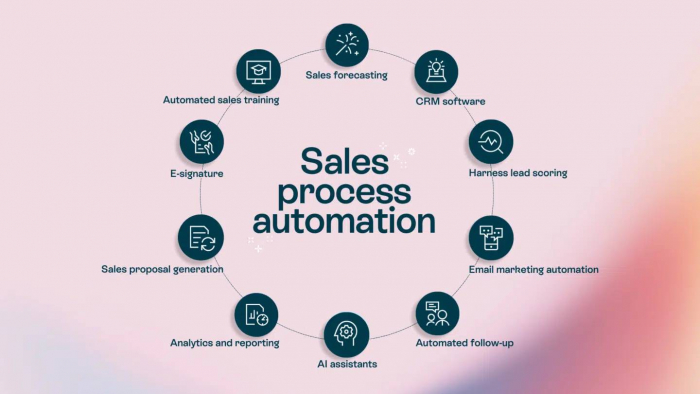
Introduction: Why Sales Automation Is No Longer OptionalToday’s B2B sales enviro...
Michael Hicklen2 months ago

Image search has quietly become one of the most powerful discovery, research, an...
Michael Hicklen2 months ago
Why Workflow Automation Matters in 2026Automation tools help businesses:● S...
Michael Hicklen2 months ago
1) Foundations :What software review platforms are-Software review platforms are...
Michael Hicklen2 months ago

1. What AI Automation in Daily Work Actually Means?1.1 AI automation in daily wo...
Michael Hicklen2 months ago
1. What Is a CRM?Definition-A CRM (Customer Relationship Management) system...
Michael Hicklen2 months ago