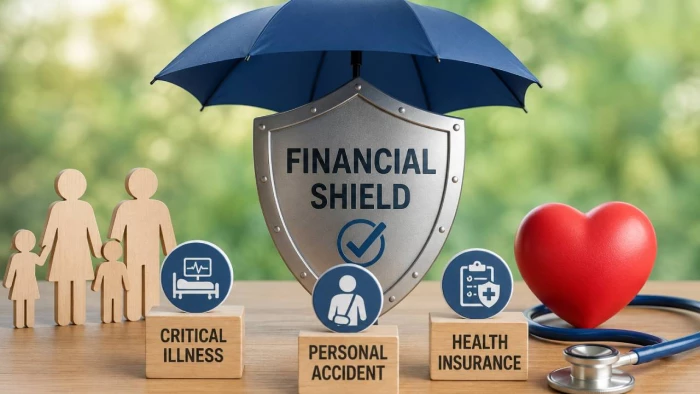
A standard health insurance policy is excellent for covering inpatient hospitalization expenses, but it rarely protects against the cascading financial hardships of a life-altering medical event. Serious health conditions require substantial medical costs, prolonged recovery times, and often lead to extended absences from work. Furthermore, with medical inflation in India climbing at an annual rate of 12% to 15%, advanced treatments can rapidly deplete a family's lifetime savings.
To build comprehensive financial security, smart planning requires combining standard health insurance with two vital pillars: Critical Illness (CI) Insurance and Personal Accident (PA) Insurance.
A Mediclaim policy is a foundational financial safety net that reimburses hospitalisation expenses when you or your family face a medical emergency. Star Health's Mediclaim plans cover inpatient treatment, day-care procedures, and pre- and post-hospitalisation expenses, with cashless access at over 14,000 network hospitals across India. Before choosing a Mediclaim plan, it is worth comparing the sum insured, room rent limits, and co-payment clauses to find one that fits your family's needs and budget. Star Health's Mediclaim plans are built on transparent policy terms, clear exclusion lists, and a strong claim settlement record that policyholders can depend on. Whether buying a Mediclaim plan for the first time or renewing an existing one, understanding the fine print upfront helps avoid surprises at claim time.
Unlike traditional health insurance that reimburses specific hospital bills, a critical illness policy provides a lump-sum payout immediately upon the diagnosis of a covered serious condition.
You can opt to purchase critical illness insurance as an add-on rider to your existing healthcare policy or as a separate standalone plan. Opting for a standalone policy typically provides a wider scope of coverage, higher available sums insured, and shorter waiting periods.
Non-Hospitalization Cost Coverage: The lump-sum payout can be used flexibly to cover lost income, daily household rents, travel to specialty clinics, or ongoing home rehabilitation expenses.
Protection for Future Goals: If the policyholder is the primary breadwinner, this payout ensures that long-term investments, EMIs, and children's education funds remain untouched during a medical emergency.
Global Treatment Options: Depending on the specific terms of your insurer, certain standalone critical illness plans may provide the financial flexibility to seek medical treatment overseas.
Number of Illnesses Covered: Most reputable Indian insurance providers cover at least 37 to 40+ critical illnesses, including multiple types of cancer, stroke, major organ transplants, and heart attacks.
The Waiting Period: Regulated by the Insurance Regulatory and Development Authority of India (IRDAI), policyholders must generally complete a 90-day waiting period from the policy's start date before making a claim.
The Survival Period: To claim the lump-sum benefit, the insured individual must survive for a specified duration—typically 15 to 30 days—following the initial diagnosis.
Common Exclusions: Claims are generally excluded if the insured passes away before the survival period ends, or if the illness stems from excessive tobacco, alcohol, or drug consumption.
A common misconception is that having a critical illness policy negates the need for personal accident insurance. In reality, these two policies safeguard against entirely distinct risks.
Personal accident insurance is highly affordable and offers substantial coverage limits for a relatively low premium, making it an essential layer of extra protection.
The optimum window to buy critical illness insurance is between 25 and 35 years of age. Securing a plan during your 20s or early 30s offers two definitive structural advantages:
Substantially Lower Premiums: Because younger individuals are statistically less prone to severe health conditions, insurers lock in highly affordable premium rates.
Early Intervention Protection: Cancer now impacts nearly 100 out of every 1 lakh people in India, and hospitals are increasingly utilizing expensive super-specialty tools like robotic surgery. Early-stage coverage lets you seek cutting-edge medical care immediately without a debilitating financial burden, drastically improving long-term recovery and survival odds.
Treating a major disease like cancer, kidney failure, or advanced cardiovascular illness in India can easily cost anywhere from ₹20 lakh to ₹30 lakh or higher, depending on the hospital and case severity.
When calculating your ideal sum insured, do not pick a random number. Instead, carefully evaluate these four core elements:
Family Medical History & Age: If hereditary conditions like stroke, heart disease, or diabetes run in your family, or as you cross the age of 40, your statistical risk increases, necessitating a higher coverage amount.
Lifestyle Risk Factors: High-stress jobs, poor nutrition, lack of exercise, or smoking habits increase vulnerability to critical ailments, making a comprehensive sum insured highly prudent.
Existing Plan Gaps: Evaluate your standard health insurance limits. Your critical illness sum should comfortably bridge the financial gap between what your regular plan pays for hospital bills and the indirect lifestyle costs of a major illness.
Outstanding Debt & Commitments: Factor in your active financial liabilities—such as home loans, car EMIs, and children's school fees—to ensure your family can seamlessly maintain their standard of living if your income stream is temporarily paused.
For protection beyond standard hospitalisation, Critical illness insurance offers a lump-sum payout on diagnosis of serious conditions like cancer, heart attack, stroke, or kidney failure. Critical illness insurance from Star Health is particularly valuable because the payout can be used for anything — treatment abroad, income replacement, or paying off liabilities — rather than being restricted to hospital bills alone. Because Critical illness insurance kicks in at diagnosis rather than at discharge, it provides financial support at exactly the moment when families most need it. Star Health's Critical illness insurance plans can be taken as standalone cover or added as a rider to an existing Mediclaim policy, depending on the level of protection needed. For anyone with a family history of serious illness, Critical illness insurance is a practical and increasingly important addition to a complete health coverage portfolio.
Share your thoughts about this article.
Be the first to post a comment!

High performers do not win solely on individual talent. They rely on good teamwo...
Terri Cruz6 days ago

A potential client searches "car accident lawyer near me" at 11 p.m. after an ar...
Terri Cruz1 week ago

Road safety is often discussed by looking at the size of a truck, yet the first...
Terri Cruz3 weeks ago

Choosing a healthcare provider for your family is a matter of weighing clinical...
Terri Cruz1 month ago

Dubai is no longer just adopting AI — it is mandating it. In 2026, the city's le...
Kruzel2 months ago

Buying a house in the UK is a big milestone, but it’s also a hidden layer of com...
Techie Frog2 months ago